

























































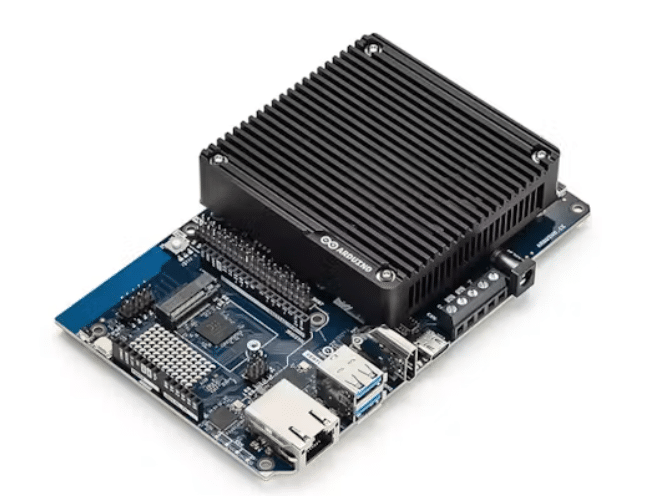

Arduino has opened pre-orders for VENTUNO Q, a powerful dual-processor single-board computer combining AI acceleration, real-time control and extensive connectivity for robotics, machine vision and edge computing applications.
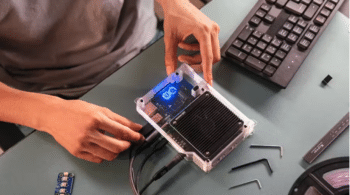
Arduino has opened pre-orders for the VENTUNO Q, a high-performance single-board computer designed to push the company deeper into edge artificial intelligence (AI), robotics and real-world automation. The board combines an eight-core Qualcomm processor with a dedicated microcontroller, creating a platform that handles both computationally intensive AI workloads and time-critical hardware control on the same system.
At the centre of the board is Qualcomm’s Dragonwing IQ-8275 processor, featuring eight 64-bit Kryo central processing unit (CPU) cores running at up to 2.35GHz, an Adreno 623 graphics processing unit (GPU) and a Hexagon DSP-based AI accelerator. The architecture delivers up to 40 trillions of operations per second (TOPS) of AI performance, targeting workloads such as computer vision, machine learning, local large language models and agentic AI applications running directly at the edge.
However, the board’s key electronics feature is its “dual-brain” architecture. Alongside the Qualcomm processor sits an STMicroelectronics STM32H5 microcontroller dedicated to real-time workloads. This separation allows the high-performance processor to manage AI inference and operating-system tasks while the microcontroller handles deterministic operations such as sensing, actuation and motor control. The two processing domains communicate through a dedicated bridge managed through the Arduino App Lab development environment.
It also represents a major jump in memory and storage compared with traditional Arduino boards. It includes 16GB of LPDDR5 RAM and 64GB of eMMC storage, with an onboard M.2 slot supporting NVMe SSD expansion. Connectivity includes tri-band Wi-Fi 6 and Bluetooth 5.3, while display options include HDMI, DisplayPort through USB Type-C Alternate Mode and MIPI DSI. The board also provides USB, CAN FD, I2C, I3C, SPI, PWM, UART and GPIO interfaces, maintaining compatibility with Arduino UNO and Modulino-format expansion hardware.
Unlike the compact microcontroller boards traditionally associated with Arduino, the board is physically larger and requires active cooling with a heatsink and fan to sustain demanding workloads. The platform is also intended to bridge the gap between prototyping and commercial deployment. Through Arduino’s ‘Works with Arduino’ programme, developers can potentially move applications developed on the board towards production-grade system-on-modules based on the same Qualcomm architecture without redesigning the complete software stack.