



















































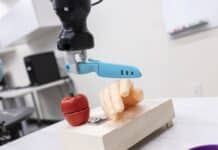

A fully open-source and 3D-printable soft robotic gripper combines the Fin-Ray effect with force sensing and low-cost electronics for cooperative object manipulation.
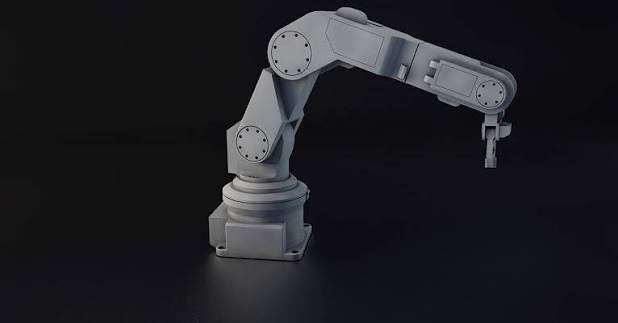
Researchers have developed a fully open-source, 3D-printable soft robotic gripper designed for cooperative manipulation by multiple robots. Inspired by the structure of fish fins, the gripper uses the Fin-Ray effect to adapt passively to different objects while combining this flexibility with piezoresistive force sensing and an STM32-based control system.
The Fin-Ray-inspired fingers are made from flexible sidewalls connected by transversal struts. When an object applies pressure to a finger, the structure bends towards the contact point, allowing it to conform to irregular shapes. The researchers evaluated different strut angles through finite-element analysis and selected a 45-degree configuration, which provided the highest compliance among the tested designs.
The fingers are manufactured using TPU through FDM 3D printing, while the mounting components and geared arms use PLA. A single servomotor drives both fingers through meshed gears, allowing the mechanism to close symmetrically and automatically centre an object. The design is intended to handle cubic objects ranging from approximately 20 × 20 × 20 cm to 30 × 30 × 30 cm.
A thin-film piezoresistive sensor mounted inside one finger provides force feedback for the control system. The sensor data is processed on an STM32F407G development board using filtering and calibration methods before being used to control the gripper. A Python interface built with PyQtGraph displays real-time information, including sensed force, target force and controller behaviour.
The project is designed specifically for multi-robot caging and transport, where several robots surround and move an object cooperatively. The researchers have released parametric CAD files, printable STL files, firmware, a bill of materials, assembly instructions and calibration data under a Creative Commons Attribution 4.0 licence. By making the complete platform openly available, the project provides an accessible foundation for research, education and experimentation in soft robotics and cooperative robot manipulation.