


















































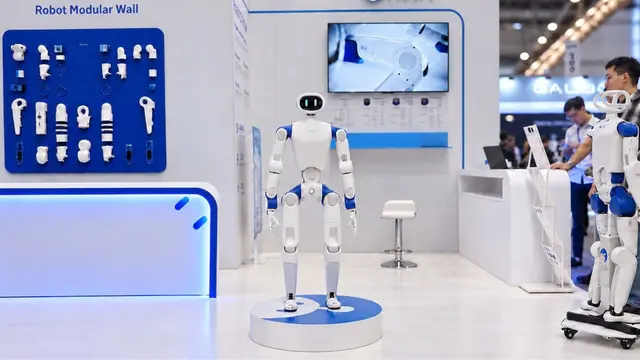

RP1 combines open hardware, control software and AI development tools to give researchers a modifiable humanoid robotics platform.
RoboParty has unveiled RP1, a full-stack open-source humanoid robot designed to give researchers, educators and developers access to a modifiable platform for embodied AI development. The company plans to progressively open the robot’s mechanical designs, actuator modules, motion-control systems, simulation environments, SDKs and training tools, extending the open approach beyond software to the wider robotics stack.
The project builds on RoboParty’s earlier ROBOTO_ORIGIN (RPO) platform, whose hardware, electronics, training and deployment resources have been released publicly. Its GitHub repositories include hardware design files, ROS 2 deployment software, reinforcement-learning training workflows, URDF and MJCF models, firmware, navigation and XR teleoperation modules. The RPO aggregation repository states that its own material is generally licensed under GPLv3, while individual modules and third-party components retain their applicable licences.
For RP1, RoboParty is extending this open approach through PartyOS, its robotics research and development platform. PartyOS incorporates the UFO framework, which uses unsupervised reinforcement learning to develop low-level motion policies for behaviours such as skill transitions, disturbance recovery and fall recovery. This allows developers to work across robot control and AI training rather than treating the physical robot and software as separate systems.
The hardware is designed for dynamic humanoid robotics, with RP1 offering up to 160Nm of peak joint torque through RoboParty’s Romomo actuator modules and real-time motion-control system. At IROS 2026, RoboParty demonstrated the platform through a “Kick Me” test in which visitors could physically disturb the robot and observe it adjust its posture and recover its balance. The demonstration showed how the open development stack can be used to test control algorithms against real-world disturbances.
RoboParty says it intends to progressively release more of RP1’s hardware and software stack, allowing developers to access, modify, train and improve the platform. The company says its developer community has grown to more than 5,000 people across research, education and maker communities, while further hardware and software releases are planned for the fourth quarter of 2026. This could give researchers and makers a broader open foundation for experimenting with humanoid locomotion, manipulation and embodied AI without having to build every layer of the robotics stack from scratch.