



























































A new rack-scale AI platform integrates high-density compute, open software and high-speed networking to accelerate inference, enterprise AI and HPC workloads while lowering deployment costs and improving scalability.
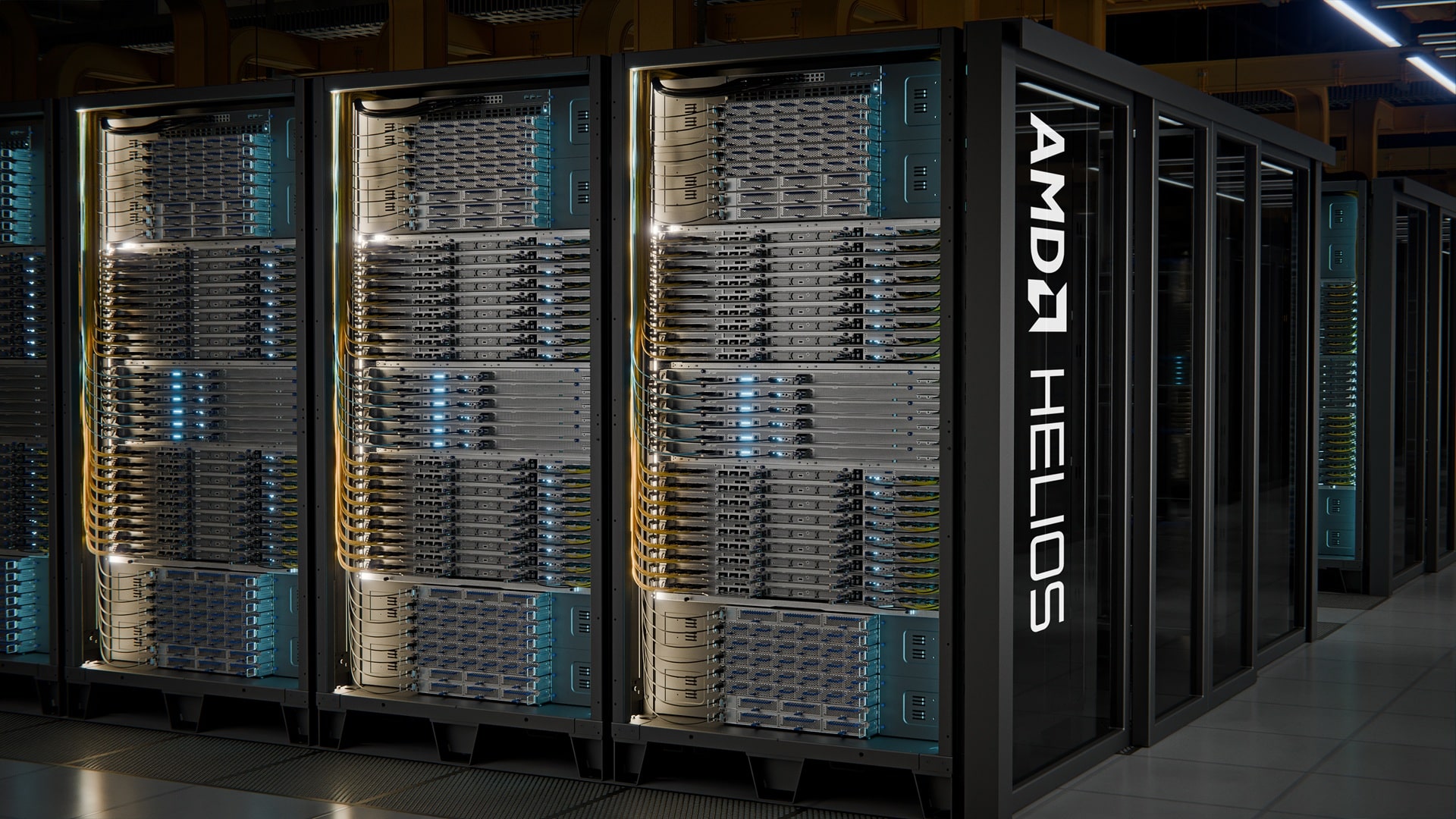
AMD has launched the Helios AI Rackscale Solution, built around the AMD Instinct MI455X GPU and 6th Gen AMD EPYC “Venice” CPU, to address the growing demand for AI inference infrastructure. As enterprises increasingly deploy large language models and agentic AI, the new platform combines compute, networking and software into a unified rack designed to maximise AI throughput while reducing operational costs.
The rack integrates 72 Instinct MI455X GPUs with 18 EPYC processors, interconnected through AMD Pensando networking and supported by the ROCm software stack. The company claims the system delivers up to 30% more inference tokens per dollar than competing rack-scale AI platforms, making it suitable for high-volume inference workloads deployed in hyperscale data centres.
The key features are:
- 72 GPUs and 18 CPUs integrated within a single rack
- High-speed Pensando scale-up and scale-out networking
- ROCm.ai enables AI-assisted GPU software development
- Compatible with PyTorch, Hugging Face, vLLM and SGLang
- Designed for hyperscale, enterprise and HPC AI deployments
The 6th Gen EPYC processors provide the memory bandwidth and processing capability required to efficiently feed multiple AI accelerators, while the MI455X GPU is claimed to offer 34× higher token throughput than the previous-generation MI355X. This combination enables faster execution of generative AI, large language models, scientific computing and other accelerator-intensive workloads.
Alongside the hardware, the company introduced ROCm.ai, an AI-assisted GPU development environment that integrates with coding assistants such as Claude, Codex and Cursor. Developers can optimise GPU applications using familiar AI tools, while support for open-source frameworks including PyTorch, Hugging Face, vLLM and SGLang simplifies migration and deployment of AI models across the company’s hardware.
The platform is targeted at cloud service providers, AI infrastructure developers, enterprise data centres and high-performance computing facilities running large-scale AI training and inference workloads. The company also confirmed that future Helios rack platforms, together with next-generation EPYC processors and Instinct GPUs, are planned as part of its long-term AI infrastructure roadmap extending through 2030.
For more information, click here.