























































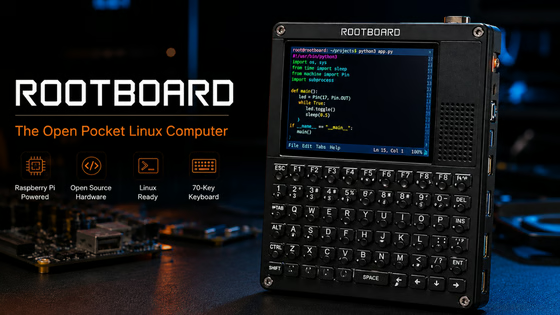

RootBoard shell pairs a 70-key keyboard and a 3.5-inch display to transform any Raspberry Pi Zero into a ultra-portable, DIY Linux terminal.
The RootBoard was launched on 1 July 2026 via a Kickstarter crowdfunding campaign. It is a compact, pocketable, open-hardware terminal shell designed in a cyberdeck form factor to turn tiny single-board computers into a portable Linux PC. Built by developer Dian Lieu, it is purpose-built for makers, developers, educators, cyberdeck builders, and Linux power users who require a mobile terminal on the go.
It is essentially a small, independent hardware outfit dedicated to designing open-source, pocketable terminal gear and cyberdecks for the maker community. The pre-assembled shell includes a 3.5-inch colour display, an integrated 70-key QWERTY membrane keyboard, built-in speakers, a rechargeable internal battery, and dedicated power-management circuitry. It features various integrated I/O ports mapped down its sides to interface directly with microcontrollers and sensors—including ESP32, Raspberry Pi Pico, Arduino, and STM32 chips for Internet-of-Things (IoT) development.
The RootBoard does not ship with an integrated processor or storage. Instead, a “bring-your-own-board” model is introduced. The physical slot natively and exclusively supports the low-power Raspberry Pi Zero-class ecosystem—such as the Raspberry Pi Zero, Zero W, and Zero 2 W—and does not support larger boards like the Pi 5. Buyers must supply their own Pi Zero board and a MicroSD card loaded with standard Raspberry Pi OS. As a true open-hardware project, the complete PCB Gerber layouts, schematics, and 3D enclosure printing files will be published publicly on GitHub.
The project recently launched via a Kickstarter crowdfunding campaign with a base tier price of approximately $115 USD, excluding shipping. Shipping and fulfilment for successful backers are scheduled to begin in November 2026.