
























































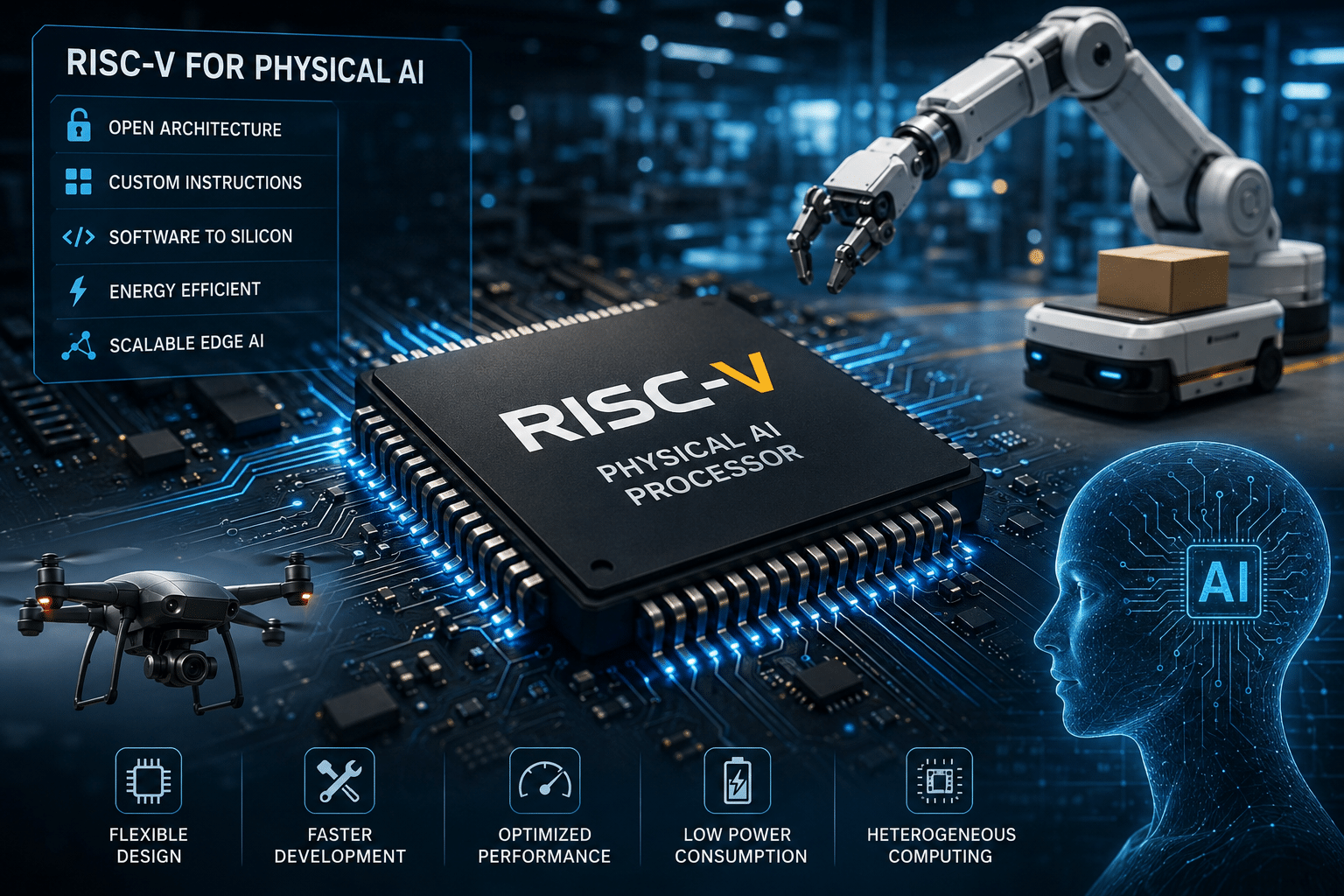

RISC-V is emerging as a key architecture for physical AI, enabling software-defined silicon, faster chip development, scalable edge intelligence, and customizable computing platforms for robotics and autonomous systems.
Physical AI is reshaping semiconductor design by driving closer integration between software development and silicon implementation, with RISC-V emerging as a flexible processor architecture for next-generation intelligent machines. As robotics, autonomous systems, and industrial automation demand real-time decision-making, developers are increasingly adopting open instruction set architectures that can be customized for specific AI workloads.
Unlike traditional AI applications confined to data centers, physical AI requires processors capable of sensing, reasoning, and acting in dynamic environments. This places new demands on semiconductor platforms, including low latency, deterministic processing, energy efficiency, and the ability to integrate diverse sensing and control functions on a single chip.
RISC-V addresses these requirements through its modular architecture, allowing chip designers to add custom instructions tailored to AI inference, robotics control, sensor fusion, and machine vision. Rather than relying on fixed processor designs, developers can optimize silicon for application-specific performance while reducing power consumption and development complexity.
The software ecosystem is evolving alongside the hardware. Modern development frameworks now enable engineers to move from software models to optimized silicon implementations with greater efficiency. Software-defined design methodologies, virtual prototyping, hardware simulation, and AI-enabled development tools are reducing the time required to validate processor architectures before fabrication, helping shorten development cycles.
Another important trend is the convergence of CPUs, AI accelerators, digital signal processors, and specialized compute engines into heterogeneous system-on-chip platforms. RISC-V’s extensibility allows these computing elements to work together while maintaining software portability across different hardware configurations. This flexibility is becoming increasingly valuable as physical AI applications expand across collaborative robots, autonomous vehicles, smart factories, drones, healthcare equipment, and edge computing devices.
The open nature of RISC-V is also encouraging broader industry collaboration. Semiconductor companies, software developers, tool providers, and research organizations are contributing to a rapidly growing ecosystem of development tools, operating systems, compilers, and AI frameworks. This collaborative model enables faster innovation while reducing dependence on proprietary processor architectures.
As physical AI workloads become more sophisticated, the transition from software algorithms to customized silicon will play an increasingly important role in delivering efficient edge intelligence. RISC-V’s combination of architectural flexibility, expanding software support, and customization capabilities positions it as a significant enabling technology for future electronics systems where intelligent machines must perceive, process, and respond in real time.