




























































An open source, low-power wheel detector uses a mechanical pedal, magnet and reed switch to record passing railway wheels for non-safety-critical monitoring applications.
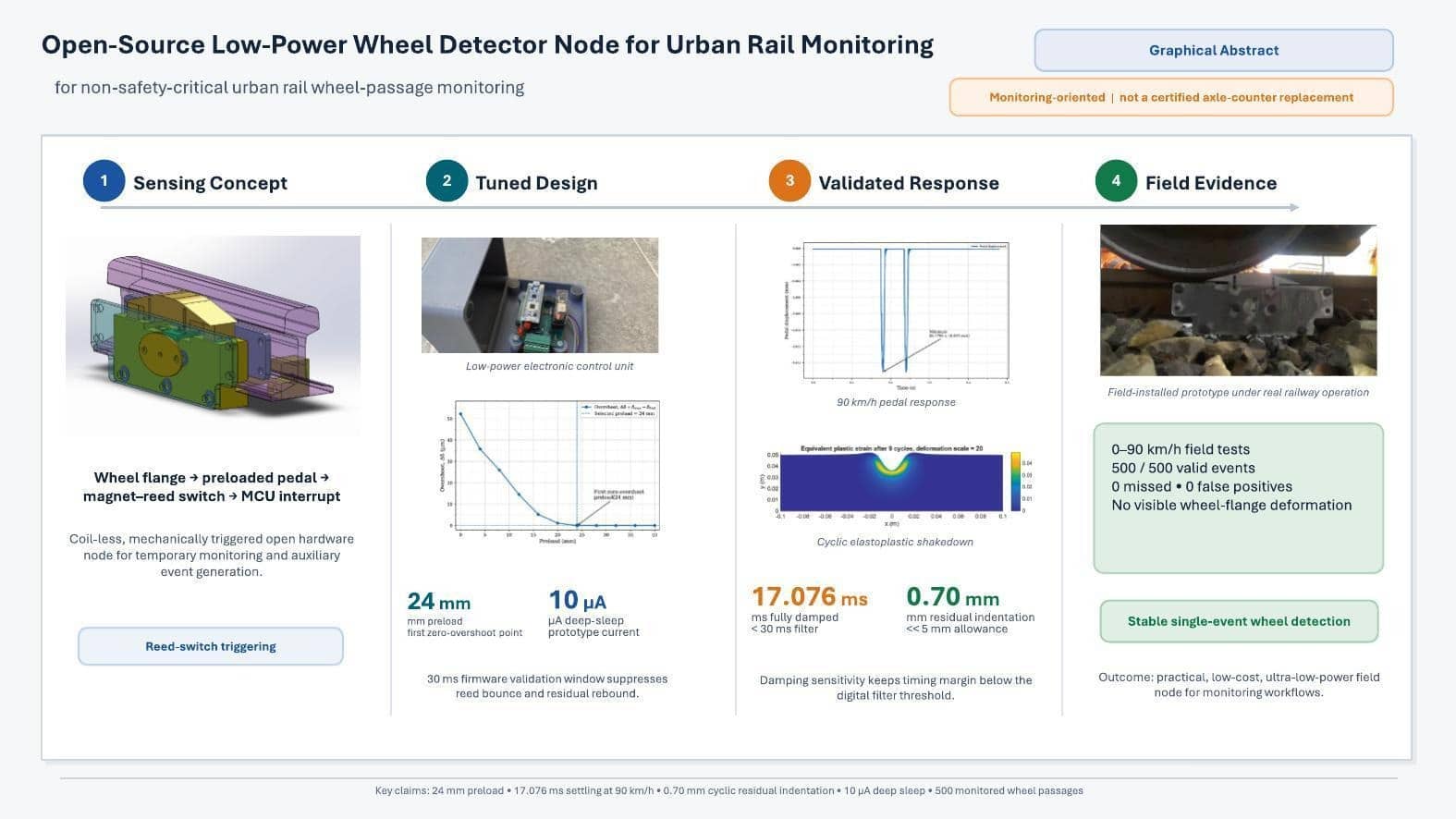
Researchers Eren Erdi, Emrah Sarioglu, Baris Oguz Gurses and Aysun Baltaci have developed an open source wheel detector for urban railway monitoring. The low-power device is designed for applications such as temporary wheel-passage logging, maintenance surveys and experimental Internet of Things monitoring. During field testing at speeds of up to 90 km/h, the prototype detected all 500 observed wheel passages without missed detections or false positives. The complete mechanical, electronic and software design is released under the CC BY 4.0 licence.
The detector is intended as a compact alternative for situations where engineers need information about wheel movements but do not require a safety-certified train detection system. It is not designed to replace certified axle counters or track circuits used for railway signalling and safety. Instead, the device can be attached to an existing rail for tasks such as counting traffic during maintenance, triggering cameras or vibration sensors, estimating train frequency and collecting localised data at sites without a fixed power supply.
At the centre of the design is a small vertical pedal mounted on the rail. When a wheel flange passes over the pedal, it moves downward and brings a permanent magnet closer to a reed switch inside the housing. The magnetic field closes the switch and generates a simple digital signal. This on-off output reduces signal-processing requirements and suits the battery-powered system, which remains in a low-power state until the reed switch triggers the microcontroller.
The electronics are built around an STM32L432KC microcontroller, with the prototype consuming approximately 10 microamperes during sleep. The system accepts an input supply between 3.7V and 13V DC and uses a 30-millisecond firmware validation window to prevent mechanical rebound or switch chatter from producing multiple wheel counts. The design files include STEP models, KiCad electronics files, fabrication outputs, enclosure geometry, firmware and MATLAB, Python and CSV validation materials.
Field testing provided the strongest validation, with the detector installed on one rail and tested using a vehicle with a known axle configuration across speeds from zero to 90 km/h. All 500 observed wheel-flange passages generated valid events, with no missed detections or false positives. However, the researchers note that longer trials are needed because factors such as temperature, water, dirt, vibration, wheel movement and long-term reed-switch ageing could affect reliability. The open source design provides researchers and railway operators with a low-cost platform for adapting and testing wheel-monitoring systems without developing an entirely new sensing platform.