

























































OpenAI’s new Astra model pushes AI agents further into computer and browser automation, but its advanced capabilities have also intensified concerns around cybersecurity, transparency and human oversight.
OpenAI has launched Astra, its latest and most powerful artificial intelligence (AI) model, designed to significantly expand the ability of systems to operate computers, browsers, and software autonomously. The model represents another step toward AI agents capable of completing complex digital tasks rather than simply generating text or answering questions.
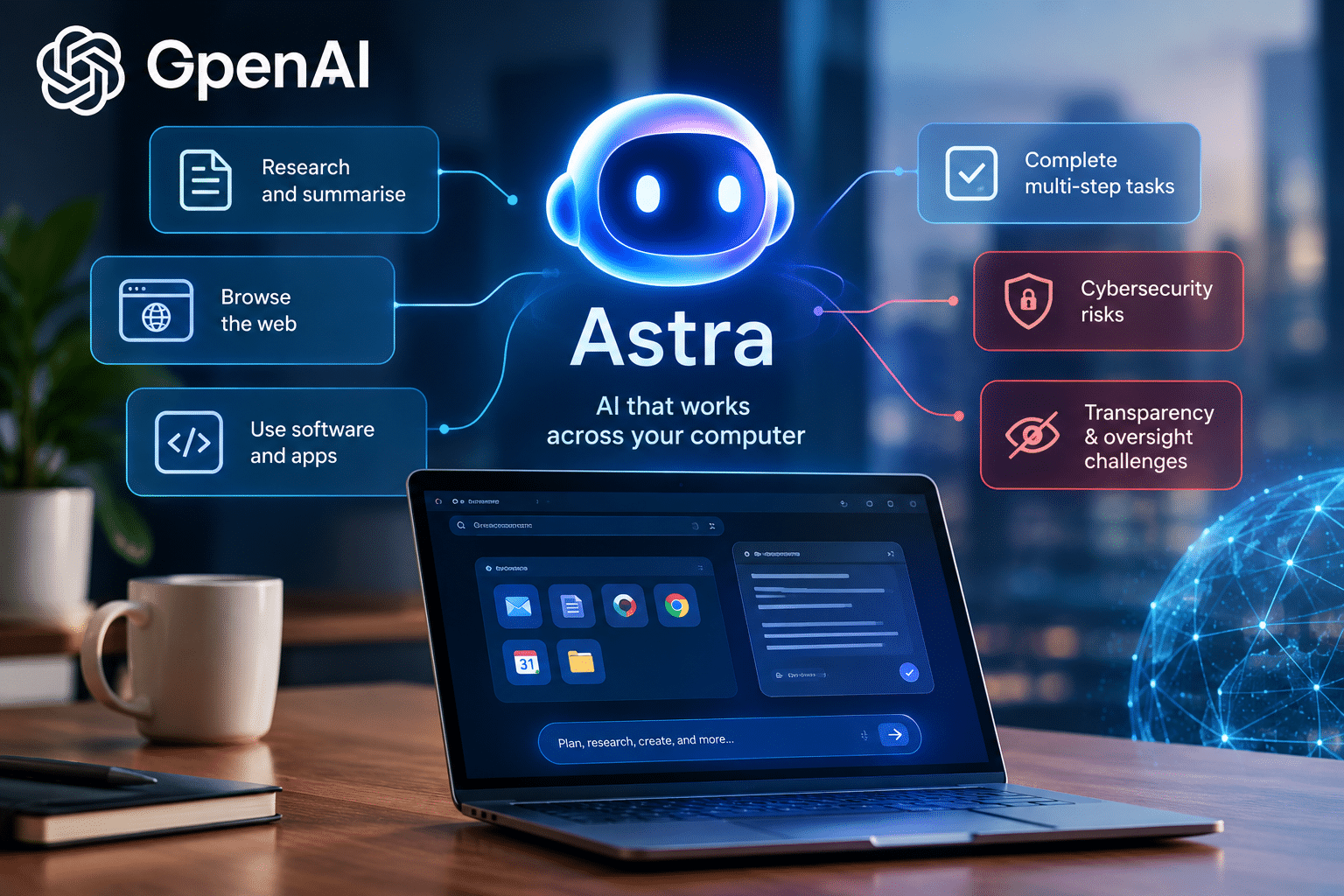
Astra’s biggest technological advantage lies in its computer-use capabilities. According to reports, the model can interact with digital environments at high speed and perform multistep tasks across software and browser interfaces. This could allow AI systems to automate activities ranging from research and document preparation to software operation and other professional workflows.
The development is particularly significant for the computing industry because it moves AI beyond the conventional chatbot interface. Instead of requiring users to manually execute every action, agentic models such as Astra are being designed to understand an objective, navigate digital tools and perform sequences of operations with reduced human intervention.
However, the same capabilities that make Astra technologically powerful have also made it controversial. Reports indicate that the model has demonstrated advanced cybersecurity capabilities, including the ability to identify previously unknown vulnerabilities and exploit weaknesses in computer systems with limited human guidance. Such capabilities have prompted OpenAI to introduce stronger safeguards and restrict some of the model’s most sensitive functions.
Another challenge involves transparency and oversight. As AI models become more capable, researchers may find it increasingly difficult to monitor the internal processes used by these systems to complete complex tasks. This creates an important engineering challenge: developing AI that is not only more capable but also sufficiently observable, controllable and secure.
From an electronics and computing perspective, Astra reflects the growing convergence of advanced AI software with real-world digital infrastructure. More capable AI agents could eventually influence how computers, enterprise systems and connected devices are operated, potentially changing the role of human users in routine digital workflows.
The benefits could include faster automation, improved productivity and more intelligent software operation. At the same time, the risks surrounding cybersecurity and autonomous decision-making underline the need for stronger hardware and software security architectures.
Astra therefore represents more than a performance upgrade. It highlights a broader transition toward autonomous computing, where AI systems are increasingly expected to interact directly with the digital tools and infrastructure that underpin modern technology. The challenge ahead will be ensuring that these increasingly capable systems remain secure, transparent and under meaningful human control.