























































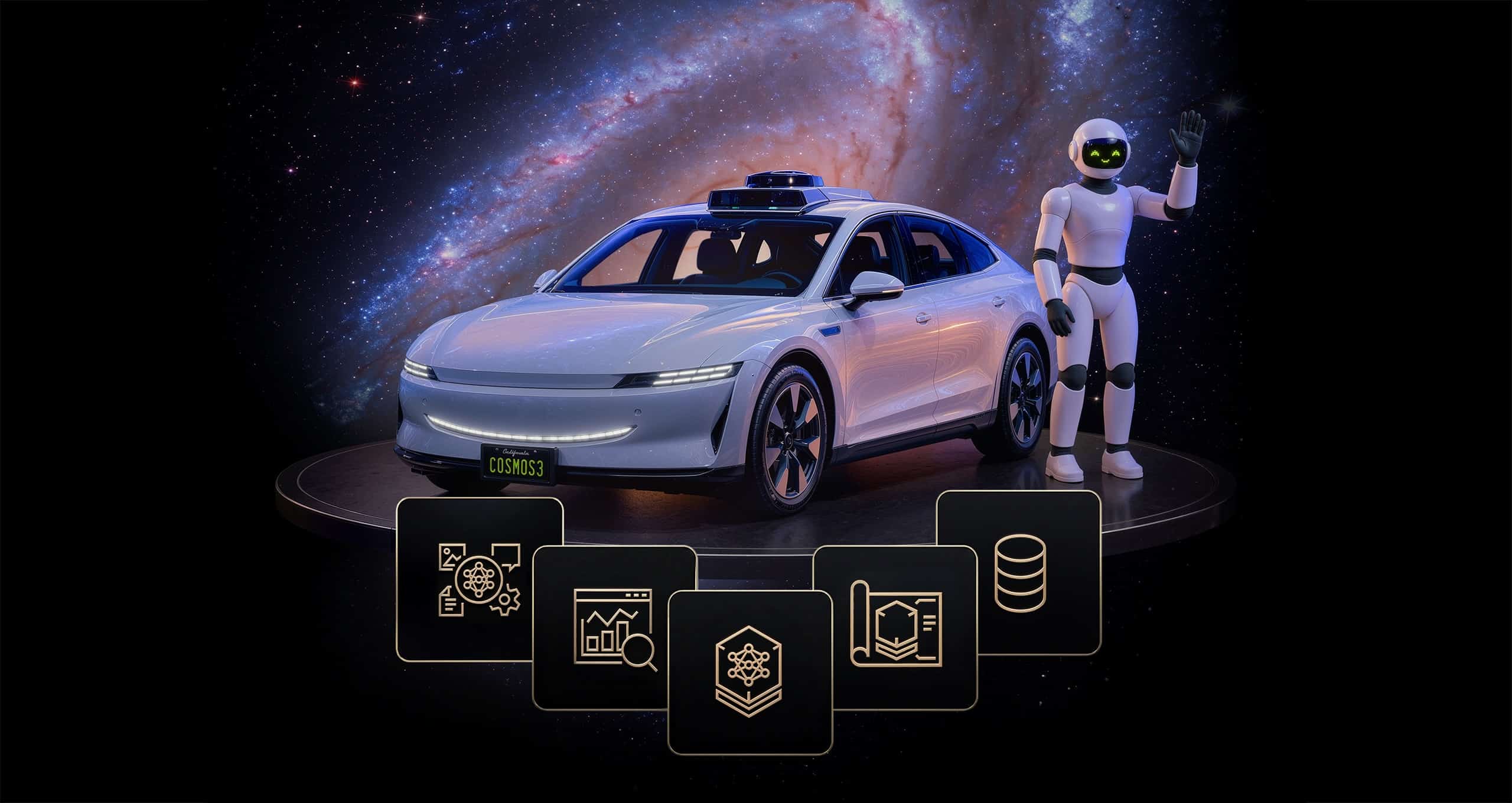

A new open multimodal foundation model is bringing advanced reasoning, world simulation and action generation into one platform, giving developers a way to build physical AI systems with less reliance on real-world training data.
The race to build physical AI is moving beyond chatbots and digital assistants. A newly unveiled open foundation model by NVIDIA targets robots, autonomous vehicles, and industrial machines by combining perception, reasoning, simulation, and action generation in a single architecture.
The platform is designed as an “omnimodel,” capable of processing and generating multiple data formats including text, images, video, ambient audio and action sequences. Developers can use it to create synthetic training environments, simulate real-world scenarios and develop AI systems that interact with physical environments rather than purely digital ones.
The key features are:
- Open multimodal foundation model supporting text, image, video, audio and action inputs.
- Mixture-of-transformers architecture optimized for physical AI reasoning.
- Native world simulation for robotics and autonomous system training.
- Synthetic data generation for large-scale AI development and testing.
- Open frameworks and tools for customization, post-training and deployment.
At the core of the release is a mixture-of-transformers architecture built for physical AI workloads. Instead of focusing only on language understanding, the model is designed to interpret objects, predict environmental changes, reason about interactions and generate actions that can be used to train robotics and autonomous systems.
One of the biggest challenges in robotics development is collecting enough real-world data to train machines safely and efficiently. The new model addresses that problem by generating synthetic data and simulated worlds that mimic real environments. Developers can create countless scenarios, test outcomes and refine AI behavior before deploying systems in factories, warehouses, vehicles or public spaces.
The platform is being positioned as fully open, with model access, development frameworks and supporting tools available for customization. This approach is intended to encourage broader adoption across robotics, vision AI, industrial digital twins and autonomous driving applications. The launch reflects a growing industry shift toward “physical AI,” where foundation models are expected not only to understand information but also to predict, simulate and influence real-world actions. As competition intensifies around robotics and autonomous systems, open world models are increasingly becoming a critical layer in future AI development.
For more information, click here.