































































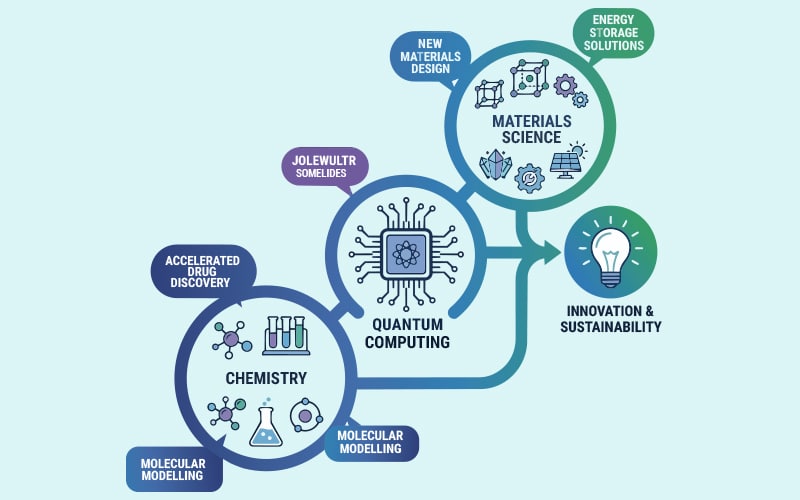

Quantum computing is steadily establishing itself as a meaningful scientific tool for chemistry and materials science, offering a new way to approach problems that have long resisted exact treatment on classical machines.
Quantum computing has moved from being a largely theoretical idea to becoming a serious research tool for some of the hardest scientific problems in chemistry and materials science. The reason is simple: nature behaves according to quantum mechanics, yet many of the systems researchers want to understand—molecules, catalysts, proteins, battery materials, and superconducting compounds—are extraordinarily difficult to model accurately with conventional computers. Even the most powerful classical systems often rely on approximations that work well for many tasks but begin to struggle when electron interactions become strongly correlated or when the number of possible configurations grows beyond practical limits.
This is where quantum computing attracts such intense interest. Instead of forcing a classical machine to imitate quantum behaviour at enormous computational cost, quantum hardware is designed to represent and process quantum states more naturally. In practice, the field is still in a hybrid phase: quantum processors are not yet replacing high-performance classical computing, but they are increasingly being paired with it to tackle selected bottlenecks in simulation, optimisation, and model building. Industry and research laboratories now view chemistry and materials science as some of the clearest long-term use cases for quantum systems, particularly because accurate molecular and materials simulations could shorten development cycles, reduce laboratory trial-and-error, and improve the odds of identifying useful compounds earlier in the research process.
The chemistry connection
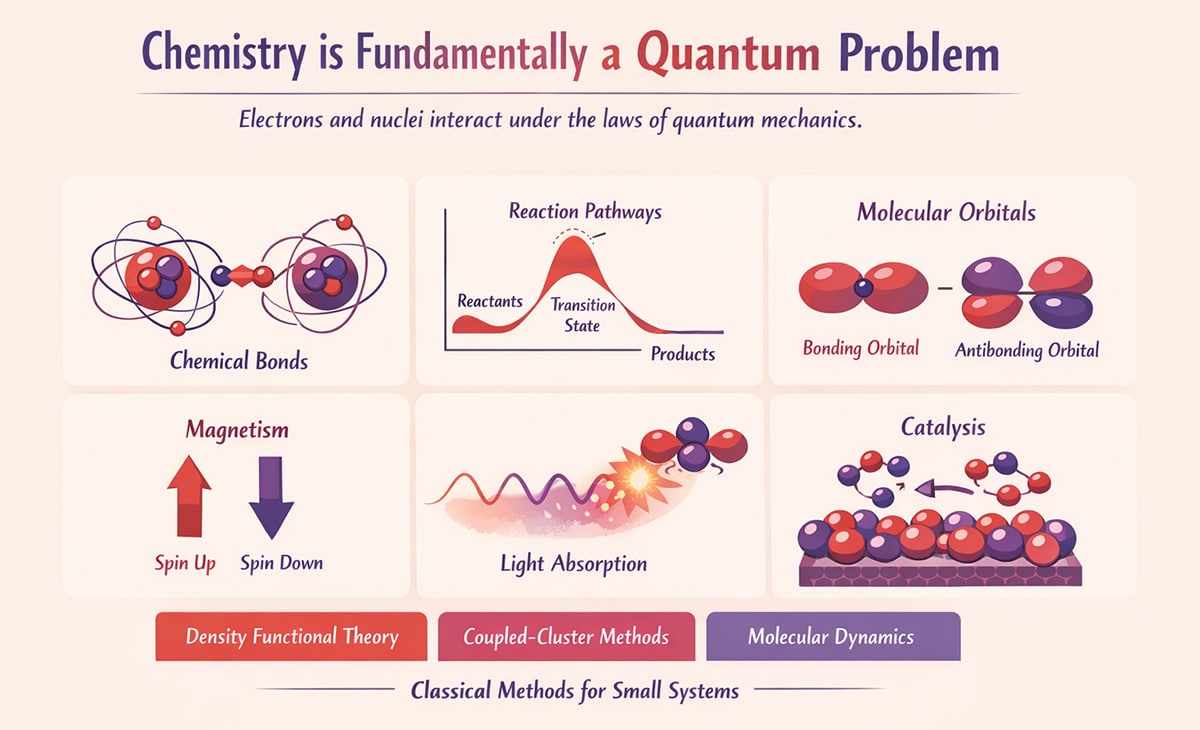
Chemistry is fundamentally a quantum problem. Chemical bonds, reaction pathways, molecular orbitals, magnetism, light absorption, and catalytic behaviour all arise from how electrons and nuclei interact under the laws of quantum mechanics. For small systems, classical methods such as density functional theory, coupled-cluster techniques, and molecular dynamics have delivered extraordinary value. However, there are important cases where these methods become either too expensive or not sufficiently reliable. This is especially true for transition-metal complexes, excited states, highly correlated electrons, charge-transfer systems, and large biomolecular environments where precision matters.
The central difficulty is that the quantum state of a molecular system scales rapidly with system size. Adding more electrons and orbitals causes the underlying mathematical description to expand combinatorially, making exact solutions intractable on conventional hardware. Quantum computers are attractive because qubits can encode and manipulate superpositions and entanglement directly, which in principle makes them far better suited to representing molecular wavefunctions than binary bits. This does not mean every chemistry problem will suddenly become easy, nor does it mean classical computing becomes irrelevant. Rather, quantum computing offers a path towards first-principles simulation in areas where today’s approximations introduce uncertainty at precisely the point where scientific and commercial decisions become expensive. That is why chemistry has long been seen as one of the most natural and credible application domains for quantum technology.
Modelling molecules: Quantum simulations
One of the most promising applications of quantum computing is molecular simulation. In drug design, catalysis, and advanced materials research, scientists need to estimate ground-state energies, reaction barriers, binding affinities, and electronic structures with enough fidelity to guide real experiments. Classical chemistry software can already do a great deal, but the hardest cases often force researchers to choose between accuracy and feasibility. Quantum simulation aims to reduce that compromise.
Current efforts largely rely on hybrid algorithms in which a classical computer prepares parts of the problem and optimises parameters, while a quantum processor evaluates chemically meaningful states. Techniques such as the Variational Quantum Eigensolver have become especially important because they can operate on noisy near-term devices while still approximating molecular energies. More advanced methods, including phase estimation and active-space embedding, are being developed for future fault-tolerant machines that could deliver chemically accurate results for larger and more complex molecules. Researchers are also using quantum-centric workflows to narrow the most important orbitals or interaction regions, allowing the quantum hardware to focus on the part of the system where classical approximations are weakest.
This is not merely an academic exercise. Recent work from research organisations and technology companies shows that quantum-assisted chemistry is steadily moving from toy molecules towards chemically richer systems, including protein-related simulations, ion complexes, and surface reactions relevant to electrochemistry. The pace is still measured, and meaningful advantage is highly problem-dependent, but the direction is clear: quantum simulation is becoming a practical complement to existing computational chemistry stacks rather than a distant scientific curiosity.
Potential for drug discovery and development
Drug discovery is one of the most compelling areas for quantum-enabled chemistry because the process depends on understanding interactions at the molecular scale, yet the search space is enormous, and failure rates remain high. Researchers must predict how candidate compounds bind to biological targets, how water and other environmental factors alter those interactions, whether a molecule is stable enough to synthesize, and whether it is likely to fail later due to toxicity or poor pharmacological behaviour. Small errors early in the pipeline can translate into years of lost effort and significant financial cost.
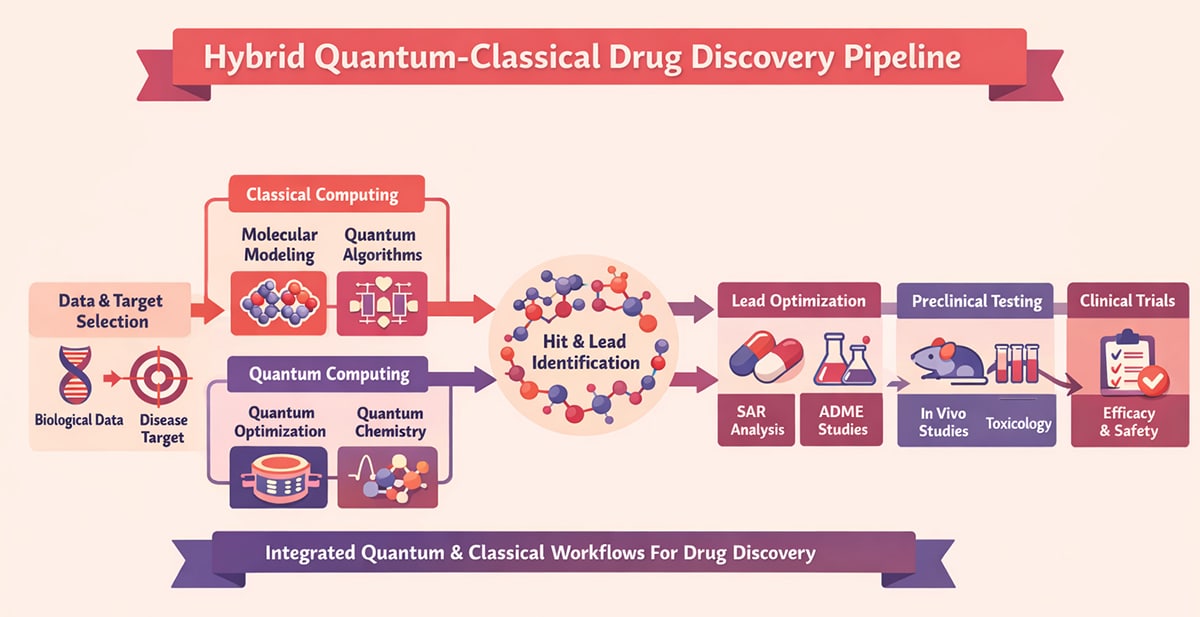
Quantum computing is attractive here because it may improve the fidelity of molecular interaction models, particularly in situations where classical approximations are weakest. Recent real-world examples show the field moving beyond theory. A hybrid quantum-classical drug discovery pipeline published in Nature in 2024 demonstrated a practical workflow for real-world pharmaceutical research, reinforcing the idea that quantum resources can be integrated into modern drug discovery rather than treated as a separate experimental track as shown in Figure 2.
Another notable example is the collaboration between Pasqal and Qubit Pharmaceuticals, highlighted in 2025, where hybrid quantum methods were applied to protein hydration analysis and ligand-protein binding. Their work focused on the difficult task of placing water molecules accurately within protein cavities, an issue that has a major influence on binding predictions and therefore on lead optimisation decisions. The reported implementation on Pasqal’s Orion system is important because it links quantum methods to a biologically meaningful task rather than a purely abstract benchmark.
There are also signs of experimental validation entering the picture. In research highlighted by St. Jude Children’s Research Hospital in 2025, investigators reported that augmenting machine-learning-based drug discovery with quantum computing outperformed comparable classical-only models in identifying promising compounds against a KRAS target. What makes this result especially significant is the claim that the work included experimental validation, which is a stronger signal of practical relevance than simulation-only studies. At a broader industry level, analyses published in 2025 argue that life sciences could derive substantial economic value from quantum-enabled molecular modelling, particularly when combined with AI to improve in silico prediction, reduce wet-lab iterations, and generate better-quality training data for downstream models.
Still, it is important to be realistic. Quantum computing has not yet transformed the pharmaceutical industry overnight, and it is not replacing medicinal chemists, structural biologists, or classical computational platforms. Its near-term role is more targeted: improving selected calculations, enriching screening workflows, and helping researchers explore chemical hypotheses that are currently too costly or uncertain to test at scale. That incremental value, however, could be highly consequential in an industry where even modest improvements in hit identification and lead optimisation matter enormously.
Materials design: From theory to application
Materials science presents a similarly strong case for quantum computing because useful materials often depend on subtle electronic effects that are difficult to capture with sufficient accuracy. Whether the goal is a better battery electrolyte, a more efficient catalyst, a higher-temperature superconductor, or a more durable semiconductor interface, success depends on understanding how atoms arrange themselves, how electrons move, and how those interactions change under real operating conditions. Classical modelling remains indispensable, yet many strategically important materials problems involve strongly correlated states, excited-state dynamics, or reactive surfaces that push conventional methods to their limits.
Recent case studies illustrate how quantum techniques are beginning to contribute. IBM researchers reported quantum-computer-based surface reaction calculations for lithium battery materials, applying embedding methods and hybrid quantum algorithms to model oxygen reduction reactions at electrode surfaces. The significance of this work lies in its focus on chemically relevant surface phenomena rather than isolated textbook molecules; in battery science, these interfacial reactions often determine efficiency, degradation, and safety. The researchers reported reaction energy estimates within chemical accuracy relative to high-level classical benchmarks for the selected active space, suggesting that quantum-assisted workflows can become useful for electrochemical materials research.
Another widely discussed real-world example comes from Microsoft’s scientific discovery program, which in 2024 used AI and high-performance computing to screen more than 32 million candidate materials and identify a novel solid-state battery material that could be synthesised. Although this milestone was driven primarily by AI and classical computation rather than by a quantum processor, it is highly relevant to the quantum computing story because Microsoft explicitly frames chemistry and materials discovery as a flagship future application for large-scale quantum systems. The case demonstrates the practical workflow that quantum computing is expected to enhance over time: massive candidate generation, computational narrowing, and faster validation of promising materials with better physics-based models.
Another example comes from a 2025 Canadian collaboration involving Xanadu, the University of Toronto, and the National Research Council of Canada. Their project aims to develop quantum algorithms for battery simulation that go beyond static ground-state estimation and instead address quantum dynamics more directly. That is an important shift because many useful materials problems, especially in electrochemistry, are inherently dynamical. If these algorithms mature, they could help scientists model charge transport, reaction kinetics, and degradation mechanisms with much greater fidelity than is currently practical.
These cases show that the road from theory to application is not a single dramatic leap. It is a layered transition in which classical simulation, AI, laboratory work, and quantum methods increasingly reinforce one another. In that sense, materials design may become one of the clearest demonstrations of quantum value because it sits at the intersection of fundamental physics, industrial relevance, and measurable performance outcomes.
Collaborations with industry: Pharma and energy
Industry collaboration has become one of the most important drivers in moving quantum computing for chemistry and materials science from theoretical promise towards application-oriented validation. The reason is practical: pharmaceutical and energy companies own many of the hardest molecular and materials problems, while quantum hardware providers, software firms, national laboratories, and universities bring the algorithms, devices, and simulation expertise needed to explore them. This has created a growing ecosystem of hybrid research partnerships in which quantum processors are not used in isolation but are integrated with high-performance computing, AI models, classical chemistry packages, and experimental validation.
In the pharmaceutical sector, collaborations increasingly focus on molecular simulation, ligand-protein interaction modelling, hydration-site prediction, conformational analysis, toxicity screening, and optimisation of lead compounds. Companies are interested in quantum computing because drug discovery depends heavily on accurate estimates of binding energies, reaction pathways, electronic structure, and molecular stability. Even small improvements in prediction accuracy can reduce the number of wet-lab experiments required during hit identification and lead optimisation. Recent collaborations, including work involving Pasqal and Qubit Pharmaceuticals, show how neutral-atom quantum systems and hybrid algorithms are being applied to biologically meaningful problems such as protein hydration and ligand binding. Similarly, research programs combining quantum computing with machine learning are beginning to explore whether quantum-enhanced features can improve compound prioritisation against challenging biological targets.
In the energy and materials sector, partnerships are strongly linked to batteries, catalysis, hydrogen production, carbon capture, solar materials, and superconductors. Energy companies and materials manufacturers face problems where electronic correlations, surface chemistry, ion transport, and reaction kinetics are central. These are precisely the domains where classical simulation can become expensive or uncertain. IBM’s work on quantum-assisted battery surface chemistry, for example, illustrates how active-space methods and hybrid quantum algorithms can be applied to reactions at electrode interfaces. Such problems are highly relevant because battery degradation, oxygen reduction, electrolyte stability, and solid-electrolyte interphase formation determine the performance and safety of next-generation energy storage systems.
These collaborations also reflect a broader shift in research methodology. Instead of waiting for fully fault-tolerant quantum computers, industry is using today’s noisy intermediate-scale quantum devices to build workflows, benchmark algorithms, train teams, and identify problem classes where future advantage may appear first. Cloud-based access to quantum processors, open source frameworks, and quantum software development kits has made it easier for industrial researchers to experiment without owning hardware. At the same time, national initiatives and public-private partnerships are supporting domain-specific quantum research in pharmaceuticals, climate technology, and advanced manufacturing.
The most successful collaborations are those that define narrow, high-value scientific questions rather than broad claims of disruption. In pharma, this may mean improving a binding-energy estimate for a difficult target. In energy, it may mean modelling a catalytic active site or battery interface with better fidelity. This targeted approach creates measurable progress and helps quantum computing become part of real industrial research pipelines.
Success stories and proof-of-concepts
The most credible success stories in quantum chemistry and materials science today are not yet full-scale industrial revolutions; they are proofs-of-concept that demonstrate scientific relevance, technical feasibility, and integration into existing research workflows. That distinction matters. In an emerging field, the most meaningful question is often not whether quantum computing has solved an entire commercial pipeline, but whether it has begun to solve pieces of the pipeline that classical tools handle imperfectly.
Several examples stand out. The 2024 report of a hybrid quantum pipeline for real-world drug discovery showed that quantum resources can be embedded within practical pharmaceutical workflows rather than remaining confined to benchmark studies. The Pasqal–Qubit Pharmaceuticals collaboration demonstrated a biologically meaningful use case in protein hydration and ligand binding, showing how quantum approaches can address molecular features that strongly influence drug efficacy predictions. The St. Jude and University of Toronto work added another important milestone by reporting experimental validation in a quantum-enhanced drug discovery setting aimed at KRAS, a target of major biomedical interest.
In materials science, IBM’s battery-surface calculations offered a practical demonstration that quantum-assisted chemistry can approach chemically relevant accuracy for reactions tied to energy storage. Meanwhile, Microsoft’s battery-material discovery effort, though primarily AI-driven, served as a compelling preview of the broader scientific discovery stack within which future quantum computers are expected to operate. Across these examples, the pattern is consistent: success is emerging first in narrowly framed, high-value tasks where hybrid methods can add insight without needing a fully mature fault-tolerant quantum machine.
Looking ahead, the strongest proofs-of-concept will likely come from domains where chemical accuracy has direct economic or societal value—drug candidate prioritisation, catalyst design, low-carbon industrial chemistry, advanced battery materials, and biomolecular modelling. As hardware improves and logical qubit counts rise, the field may move from demonstrating isolated wins to delivering repeatable, domain-specific advantages.
Long-term prospects in science and industry
As hardware matures from noisy devices towards fault-tolerant machines with logical qubits and reliable error correction, quantum computers may eventually perform simulations that are beyond the practical reach of even the largest classical supercomputers.
In scientific research, one of the most important long-term outcomes will be more accurate first-principles modelling. Fault-tolerant quantum algorithms such as quantum phase estimation, qubitization, quantum signal processing, and advanced Hamiltonian simulation could enable chemically accurate calculations for larger active spaces than those accessible today. This may transform how researchers study reaction mechanisms, catalytic cycles, photochemical processes, and electron-transfer phenomena. Instead of relying heavily on empirical approximations or small benchmark models, scientists could explore molecular and materials behaviour with higher predictive confidence. This would be particularly valuable in fields such as nitrogen fixation, green ammonia production, carbon dioxide reduction, hydrogen catalysis, and next-generation semiconductor materials.
From an industrial perspective, quantum computing is likely to become part of a broader scientific discovery stack rather than a standalone replacement for classical computing. The future workflow will combine AI for candidate generation, high-performance computing for large-scale screening, quantum processors for high-accuracy treatment of selected quantum subproblems, and automated laboratories for synthesis and testing. In this model, quantum computing contributes most where precision is expensive but scientifically decisive. For example, an AI model may generate thousands of candidate battery electrolytes, classical simulation may filter them, and a quantum algorithm may evaluate the most difficult electronic-structure regions before experimental validation.
The timeline for broad commercial advantage remains uncertain. Near-term devices will continue to be limited by noise, circuit depth, qubit connectivity, and error rates. However, progress in error mitigation, quantum embedding, tensor-network integration, active-space selection, and hybrid quantum-classical algorithms is steadily improving the usefulness of current systems. Over the longer term, advances in logical qubits, scalable control systems, cryogenic engineering, photonic interconnects, and quantum error correction will determine how quickly chemistry-scale quantum advantage becomes practical.
If these technical barriers are overcome, the industrial impact could be considerable. Quantum-enhanced molecular and materials design may reduce development cycles, lower R&D costs, improve catalyst efficiency, accelerate drug discovery, support cleaner energy technologies, and enable materials with properties that are difficult to discover through trial-and-error alone. The most realistic long-term vision is not that quantum computing replaces chemists, materials scientists, or classical simulation, but that it gives them a more powerful instrument for understanding and engineering matter at its most fundamental level.
The most encouraging progress so far has come through hybrid workflows, where quantum systems work alongside classical computing, AI, and laboratory experimentation. Looking ahead, the real promise of quantum computing is not a single dramatic breakthrough, but the gradual expansion of scientific capability—better models, faster discovery cycles, and more informed decisions in areas where precision matters deeply.